
Join us for a webinar on October 26th where we will explore the findings of this report! Learn more and register here.
Cette ressource est également disponible en français.
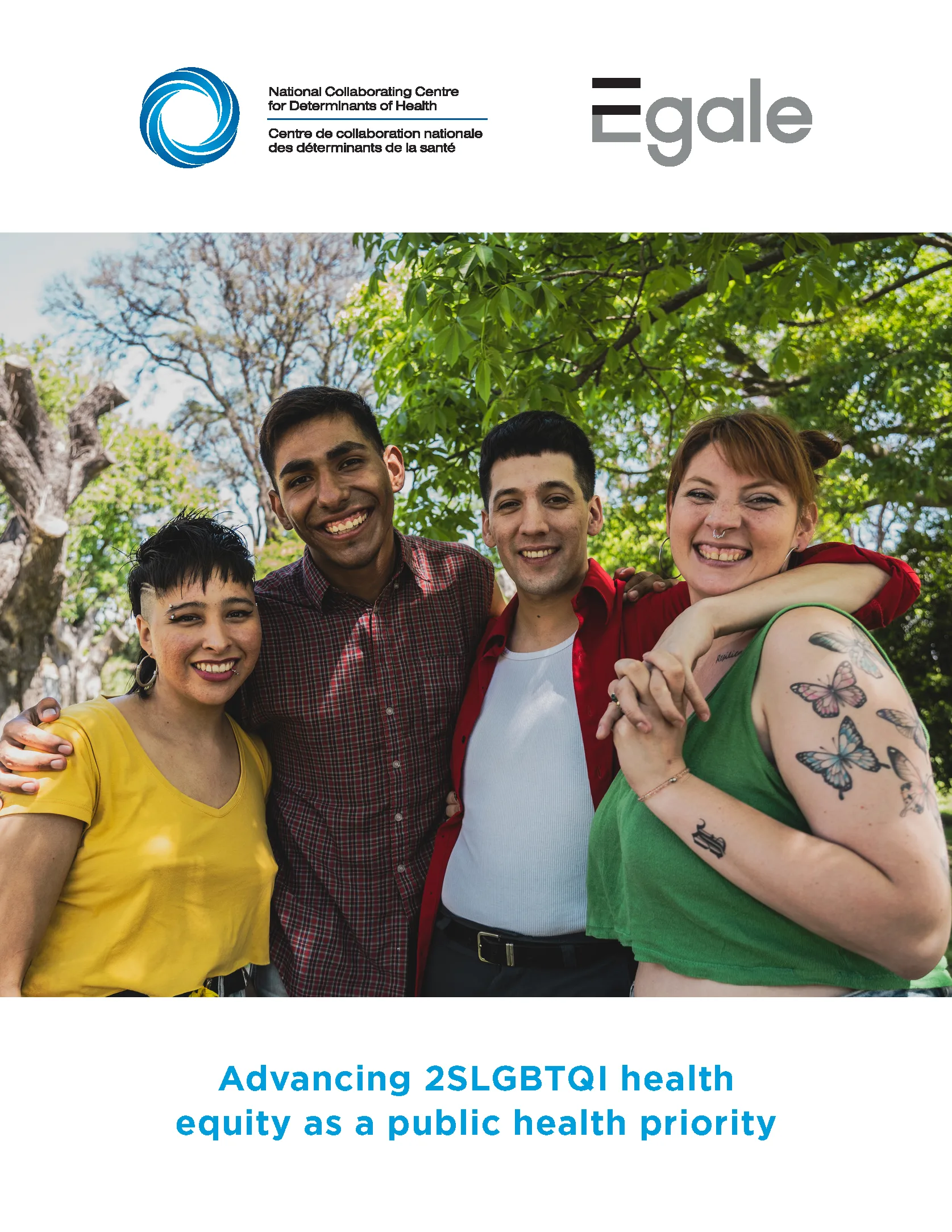
Health is a human right. Yet many 2SLGBTQI (Two-Spirit, lesbian, gay, bisexual, transgender, queer, intersex) people in Canada experience significant health inequities due to multiple and intersecting oppressions, stigma, discrimination, and barriers to health care, including within and across public health. To highlight this issue and position 2SLGBTQI health equity as a public health priority, the NCCDH and Egale Canada collaborated to bring together research evidence, practice-based knowledge and public health perspectives on this topic.
2SLGBTQI health equity is a public health priority
This resource describes gender-affirming public health as “how public health at all levels affirms gender diversity and expression in all aspects of its work.” It further explains that “providing access to services free of stigma, discrimination and assumptions is upholding the human rights of trans and gender-diverse people” (p. X). Implementing gender-affirming public health approaches and directly addressing the inequities faced by 2SLGBTQI people align with provincial and territorial public health mandates and with the Core competencies for public health in Canada: Release 2.0.
Bringing together research and practice perspectives
Key drivers of health inequities experienced by 2SLGBTQI people are rooted in the structural and social determinants of health. Minority stress, lack of cultural safety, stigma and discrimination, and significant mental distress and lack of access to care represent significant barriers to health. In this context, an NCCDH webinar series on 2SLGBTQI health brought together research and practice perspectives to identify key concerns — including challenges in accessing services, fear of mistreatment and inadequate care, and intersectional issues — and to outline public health roles to address them. The webinars also identified focusing on system-level action, creating inclusive spaces and shifting individual interactions as ways to support 2SLGBTQI people, as well as providers, and to foster safer public health organizations.
Considerations for public health
Living and acting in allyship, demystifying myths and prejudices, shifting to gender-inclusive language, and engaging authentically with 2SLGBTQI people are essential components of gender-affirming public health. Other key roles for public health in advancing 2SLGBTQI health equity are actively facilitating change in community, school and health care settings, and supporting ongoing professional development.
Use this resource to
- Facilitate discussion about individual actions, words and strategies to practise advocacy and allyship with 2SLGBTQI folks
- Develop a work plan to address 2SLGBTQI health inequities that identifies actions across public health programs and disciplines
- Support policy and practice change at all levels of public health to address the structural and social causes of 2SLGBTQI health inequities
Related resources
Gender identity, sexual diversity and health equity: A curated list
Disrupting colonialism for Two-Spirit health (Mind the Disruption, Season 1, Episode 6)
Webinar: Gender identity, sexual diversity and health equity in public health
Webinar: Promoting the rights and health of transgender people as a public health equity priority
Reference
National Collaborating Centre for Determinants of Health; Egale Canada. (2026). Advancing 2SLGBTQI health equity as a public health priority. Antigonish, NS: NCCDH, St. Francis Xavier University.