
2022 Report card on child and family poverty in Canada
This national 2022 Report Card from Campaign 2000 analyzes tax data and includes policy recommendations to eradicate child and family poverty.

This national 2022 Report Card from Campaign 2000 analyzes tax data and includes policy recommendations to eradicate child and family poverty.

This Equity in Action story is distilled from an interview with The interview took place in June 2021, and its details should be considered within the context of that time period. This school health nurses initiative did not entirely level the playing field, but it certainly increased public health’s capacity to support our school communities
This report presents data on key indicators of child and youth wellbeing in the province of Nova Scotia, Canada, and includes recommendations for action on poverty and systemic racism as the most urgent threats.
This systematic review article from Samji et al. explores the impact of COVID-19 on the mental health of children and adolescents, including risk factors such as age, gender, neurodiversity, and chronic conditions. Interventions to mitigate short- and long-term negative impacts on mental health, including family and social supports, are described.

In this framework description, Dr. Julie James discusses the importance of engaging with, and following the lead of, trans and gender-diverse youth. She presents a framework her team developed that can be used to guide public health action to shift personal and organizational knowledge, attitudes and approaches; it can also be used to provide competent services to trans, Two-Spirit and/or gender diverse youth.
This webinar took place in English. This webinar was co-hosted by the National Collaborating Centre for Determinants of Health (NCCDH) and the National Collaborating Centre for Methods and Tools (NCCMT). Program planning is one of the core roles of public health and community organizations, establishing clear direction, priorities and methods for measuring success. Tools and frameworks

In this blog post, Knowledge Translation Specialist Dianne Oickle discusses what to consider for multisectoral and relational work to address early childhood health inequities in Canada.

In this blog post, Knowledge Translation Specialist Dianne Oickle discusses how inequities in early childhood have a longstanding effect on a person’s health outcomes.
This webinar will took place in English. Conditions in early childhood shape our health at all stages of the life course. In Canada, health inequities in early childhood (generally referred to as 0–6 years of age) are experienced the most by children who are Indigenous, living in poverty and surrounded by unhealthy physical and social
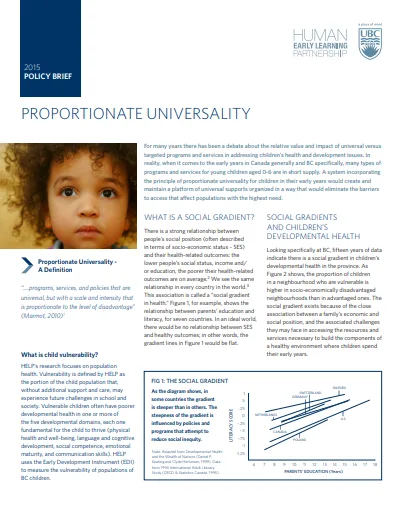
This policy brief from the Human Early Learning Partnership (HELP) provides an overview of the concept of proportionate universality, how it applies to child health and the importance of shifting the social gradient through universal and targeted programs for early childhood development.
We have a new look! Explore our redesigned website.
Find all the same content and features with a refreshed look. Be patient with us, we are actively working on finding and fixing glitches and bugs that resulted from this big transition. If you find something that’s not working as you think it should please let us know at nccdh@stfx.ca.