
Unequal: Social inequalities in health
This animated video uses population data to illustrate the differing life-long influences of social inequalities on underprivileged and affluent citizens.
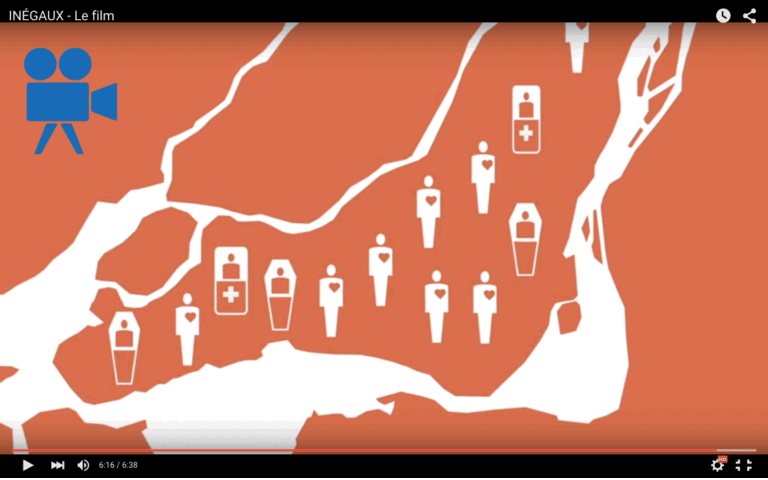
This animated video uses population data to illustrate the differing life-long influences of social inequalities on underprivileged and affluent citizens.
This document summarizes an online conversation—hosted by the NCCDH in 2013— about the use and value of a four-role model for public health action to improve health equity.
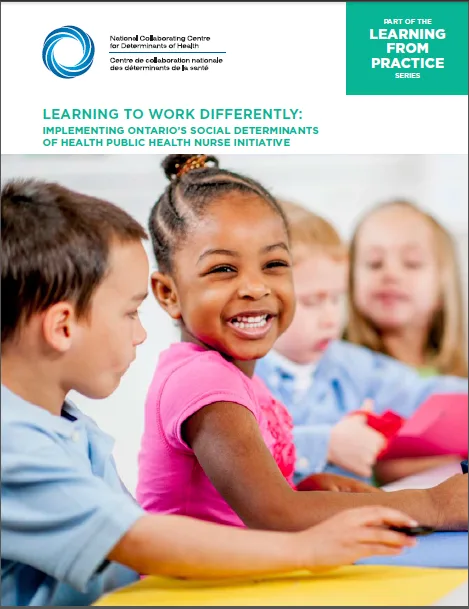
This case study explores the development and implementation of social determinant of health public health nurse (SDH PHN) positions across Ontario’s 36 public health agencies. The report explores the supports and barriers to implementing equity-focused positions to improve public health organization capacity to act on SDH and advance health equity. This is one of a series of case studies about leadership for health equity.
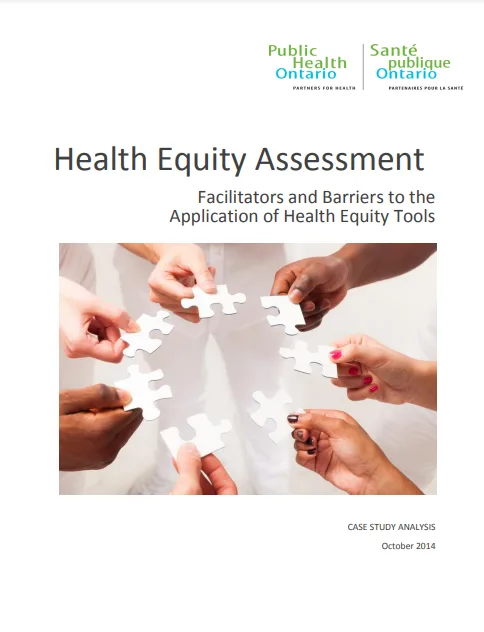
The authors of this document analysed the application of health equity assessment tools (HEATs) in Australia, New Zealand, United Kingdom and Canada to identify facilitators and barriers to success.
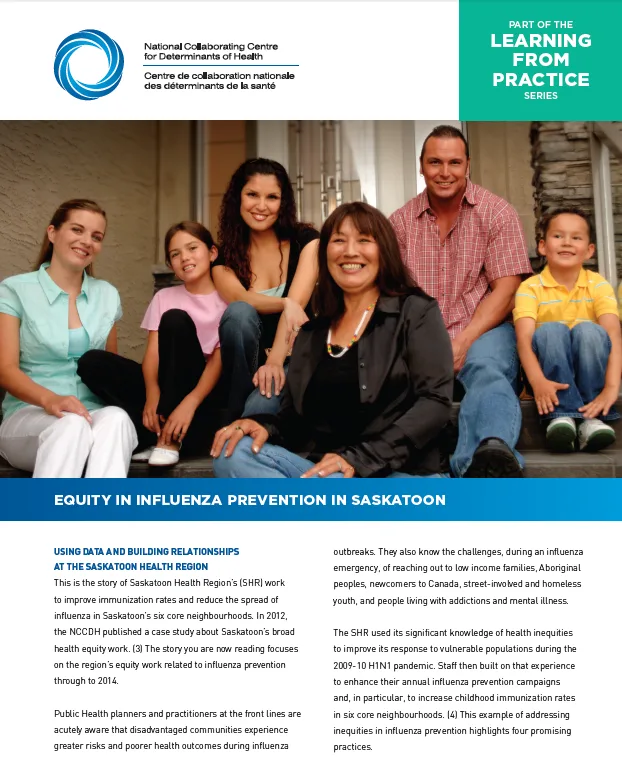
This is the story of Saskatoon Health Region’s (SHR) work to improve immunization rates and reduce the spread of influenza in Saskatoon’s six core neighbourhoods. SHR’s existing strong socio-economic and health disparities data made it possible to prioritize these core neighbourhoods for H1N1 vaccination programs.
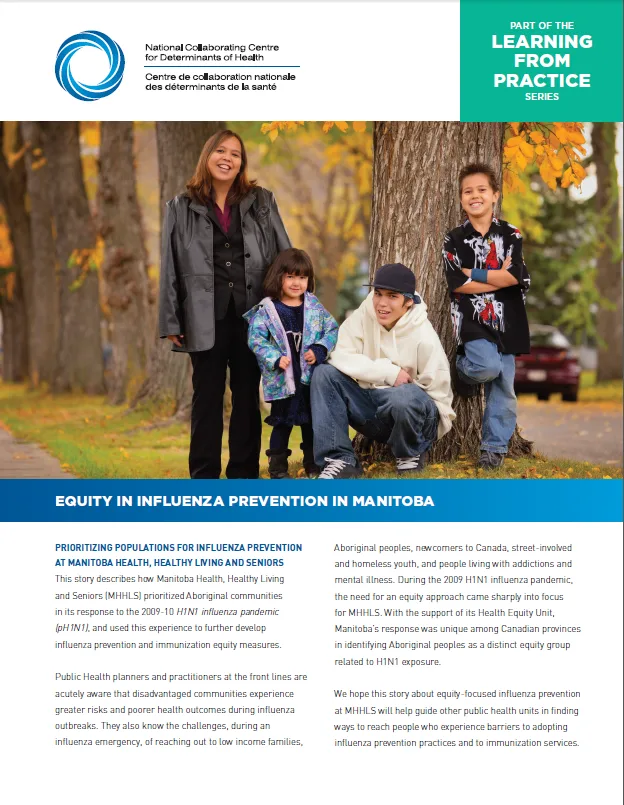
This story describes how Manitoba Health, Healthy Living and Seniors prioritized Aboriginal peoples in its response to the 2009-10 H1N1 influenza pandemic, and used this experience to further develop influenza prevention and immunization equity measures.

First in a series of five policy briefs describing practical actions to address inequities in health facing Europe, The equity action spectrum describes a framework that can be used by regions to develop comprehensive and systematic ways to address inequities in health.
This report examines 13 programs or policies that have had some success in reducing health inequalities in Canada. All of the selected interventions set out to reduce health inequities through the social determinants of health, and they were evaluated using current medical evidence-based standards.
In this video, public health decision-makers and researchers describe “targeted universalism” as an approach to reducing health inequities across the entire population.
In this video, public health decision-makers and researchers describe how data can be used to deliberately uncover the health equity and the social determinants of health picture in communities.
We have a new look! Explore our redesigned website.
Find all the same content and features with a refreshed look. Be patient with us, we are actively working on finding and fixing glitches and bugs that resulted from this big transition. If you find something that’s not working as you think it should please let us know at nccdh@stfx.ca.