
Keyword: Racism/racialization

Racism/racialization

Integrating equity into employment

In this blog post by NCCDH Program Manager Faith Layden and NCCDH Scientific Director Connie Clement, the authors discuss the protocols and resources used to promote racial equity in the organization’s hiring processes.


Reflections of a Black woman on racism, Indigeneity and Otherness in Canada

This blog post is part of a series on an anti-racism initiative at the NCCDH. The post is a personal reflection authored by an NCCDH staff member and is focused on her experiences of racism as a Black woman, intersections between settler colonialism and colonialism experienced elsewhere and reflections on relationships with Indigeneity.

Indigenous cultural safety: Necessary for Indigenous health

In this blog post, I unpack some of the concepts discussed in a recent NCCDH-hosted webinar on Indigenous health promotion, tying them to ideas brought up in a workshop on Indigenous cultural safety at TOPHC 2018. I am a White settler who lives and works in Waterloo, Ontario, on the Haldimand Tract, the traditional territory of the Neutral, Anishnaabeg and Haudenosauonee peoples.

Imagine 2048: A reflection on the future of health promotion practice

Imagine the world in 2048. What do you see? I imagine a world in which a greater proportion of humanity gets to partake in the beauty and bounty the world has to offer while being buffered from more of its downsides. It brings to mind what Arundhati Roy imagines as “another world.” In this “another world” described by Roy, three things will be central to health promotion practice.

NCCDH staff becoming anti-racist through informed dialogue: 2 of 2

Our staff team at the National Collaborating Centre for the Determinants of Health (NCCDH) is engaged in a long-term initiative to become anti-racist, in part by engaging in staff readings and guided discussions. This blog post describes our group conversation process and the sessions we held between June 2017 and January 2018. See the companion blog post, “NCCDH staff becoming anti-racist through informed dialogue: 1 of 2,” for an introduction to this blog post.

NCCDH staff becoming anti-racist through informed dialogue: 1 of 2

In the summer and fall of 2016, the National Collaborating Centre for Determinants of Health (NCCDH) initiated an all-staff process to become more anti-racist. My first “Becoming anti-racist” post from March 2017 describes the NCCDH’s intention to hold monthly learning discussions and introduces the circle way method that we adopted. My more recent entries report on our discussions and the resources we used to help us learn.

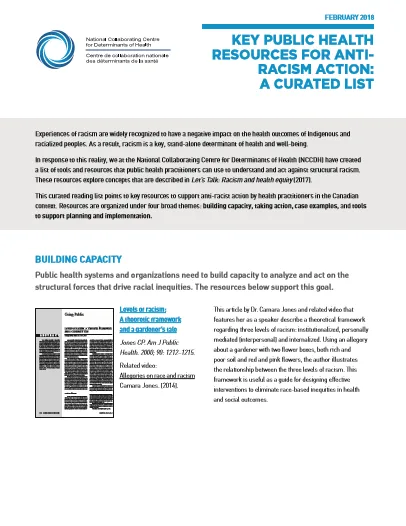
Key public health resources for anti-racism action: A curated list

This reading list is designed to offer a starting point for public health practitioners hoping to deepen their understanding of the causes and implications of structural racism. In addition, the collection highlights different strategies for dismantling racist systems and offers examples of communities that have experience success with these aims.

Equity-focused public health practice as a strategy to tackle TB

Tuberculosis (TB) is impacted by many social determinants of health, which leads to inequities in who is affected by the disease and how it manifests in the population. A shift in public health approach that addresses health equity as the primary focus could contribute to the elimination of TB, in addition to addressing other health inequities across the population.

Plenary from Public Health 2017: Racism in Society

One way that public health organizations can help dismantle racism is by facilitating conversations about how racial inequity plays out in social, scientific and legislative arenas. It is with this aim that I moderated the closing plenary session at the annual pan-Canadian public health gathering, Public Health 2017, in Halifax, NS, located in Mi’kma’ki, the ancestral and unceded territory of the Mi’kmaq People.

Scroll to Top
This site is registered on wpml.org as a development site. Switch to a production site key to remove this banner.