
Ethical foundations of health equity: A curated list
This curated reading list includes resources that explore the ethical foundations of health equity and the implications for public health action.
This curated reading list includes resources that explore the ethical foundations of health equity and the implications for public health action.
In September 2018, the NCCDH brought together three leaders in public health practice and research to share their experiences and reflections on public health practice and action to advance health equity through the built environment. This resource summarizes that conversation, facilitated by Dr. Teri Emrich, knowledge translation specialist at the NCCDH.

In this blog post, Knowledge Translation Specialist Dianne Oickle discusses what to consider for multisectoral and relational work to address early childhood health inequities in Canada.
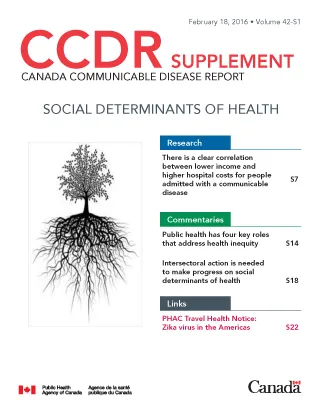
This 2016 supplemental document to the Public Health Agency of Canada’s Canada Communicable Disease Report (CCDR) has a focus on social determinants of health and how infectious disease prevention and control intersect with health equity.
This curated list from the National Collaborating Centre for Determinants of Health (NCCDH) highlights resources that support and inform public health action on housing as a key influence on health equity.
This report offers research results from Ontario-based initiative RentSafe, a project that seeks to address the underlying circumstances that contribute to unhealthy housing and identify potential solutions and actions that will lead to healthy housing for all.
This user guide describes a set of indicators that can be used to assess and demonstrate actions being taken by public health organizations in working towards health equity.

The Canadian Institute for Child Health (CICH) profile offers data from over 400 indicators on the health and well-being of Canadian children and youth. New modules on Indigenous children/youth and health/development in the early years consolidate indicators that can be used to support strategies, draw attention to health inequities and develop partnerships that serve the children of Canada, Indigenous and settler alike.

The NCCDH recently participated in the first full gathering of the Multisectoral Urban Systems for Health and Equity in Canadian Cities (MUSE) project, a Canada-wide initiative to analyze how local municipalities, public health and community organizations work together to design our cities to promote fair distribution of health outcomes.
A groundswell of interest has emerged recently in using collective impact (CI) to tackle entrenched social problems. This blended case story describes two CI initiatives in which public health is significantly involved: London Ontario’s Child & Youth Network and The Child & Youth Health Network on Vancouver Island.
We have a new look! Explore our redesigned website.
Find all the same content and features with a refreshed look. Be patient with us, we are actively working on finding and fixing glitches and bugs that resulted from this big transition. If you find something that’s not working as you think it should please let us know at nccdh@stfx.ca.