
Health equity audit: A self-assessment tool
This self-assessment tool can help you gather evidence on health inequities to support and develop policies and programs that distribute resources on the basis of health need.

This self-assessment tool can help you gather evidence on health inequities to support and develop policies and programs that distribute resources on the basis of health need.
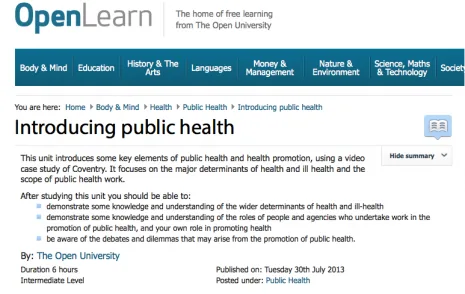
This free, online course introduces the scope of public health practice, with a focus on initiatives related to the determinants of ill health. It revolves around a case study, presented in a video, of public health’s role and activities in Coventry, England.
This 45-hour, online course was designed for public health practitioners and decision makers who want to develop or improve their ability to lead a health impact assessment of public policies that involves working with partners from multiple sectors.
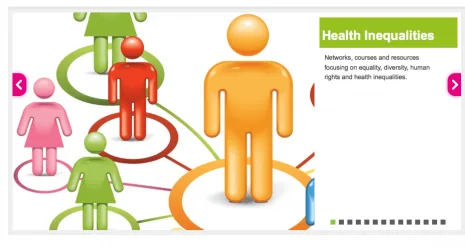
This free, six to 12 hour course is designed using case studies to teach public health practitioners how to conduct a health impact assessment (HIA). The course was developed by the National Health Service in Scotland, which has produced an impressive eLearning program of study.
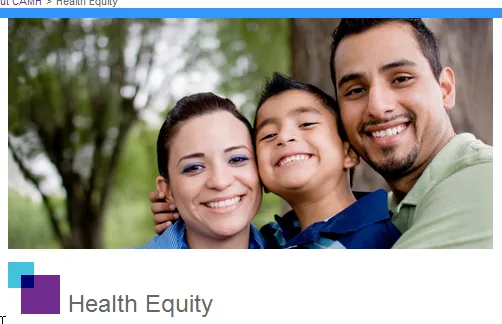
This free, skill-building course teaches why and how to conduct a health equity impact assessment (HEIA), and gives learners opportunities to complete up to five HEIA templates – a tool designed by the Ontario Ministry of Health and Long-Term Care – based on five case studies.
This free, three-hour online course was designed to increase the awareness and skills of civil servants in applying gender-based analysis to the development of government policies and programs.
This paper introduces the conceptual framework that guides the work of the WHO’s Commission on the Social Determinants of Health. The document describes how the framework came about, its two “levels of causation’ of health inequities, and the “policy directions” it points to.
This paper describes the national health equity strategies of 14 European countries. Based on this survey, the authors present the challenges and key conditions for success for an effective national strategy that can help reduce the unequal distribution of health and its social determinants.
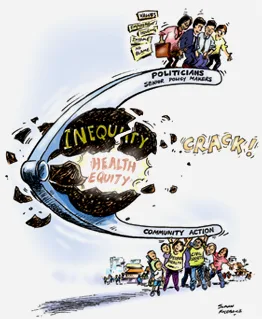
In this classic paper, the author identifies the factors most likely to encourage action on the social determinants of health: leaders who are committed to justice and can work with others through complexity, and citizens who advocate for social environments that allow individuals to make healthy choices.
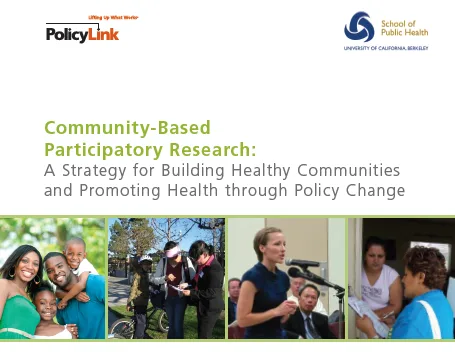
Community-based, participatory research is a change strategy that involves citizens and researchers, equitably. This report outlines eight promising practices drawn from American experiences, presents six case studies, and directs the reader to dozens of tools and resources.