
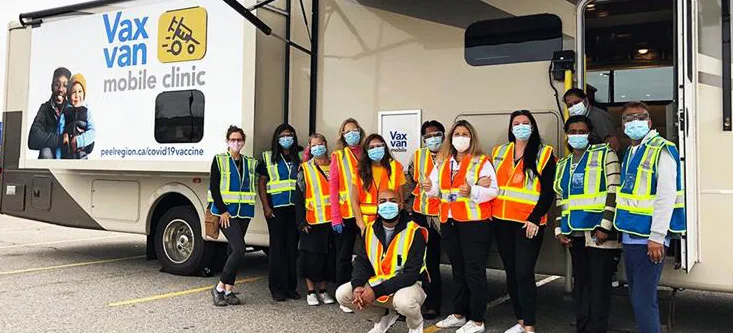
This Equity in Action story is distilled from an interview with Liz Estey Noad, Director of Health Equity, Partnership and Innovation (formerly Director of Transition and Transformation, Peel Public Health), and Brian Laundry, Director of Strategic Policy and Performance, Department of Health Services (formerly co-lead for Peel’s Mass Vaccination Program), Peel Region, Ontario. The original interview took place in February 2023 and its details should be considered within the context of that time period.
Peel Public Health successfully broke down barriers to COVID-19 immunization in its region by redistributing and rebalancing power between public health decision-makers and community leaders, members, organizations and partners. Working from a foundation of humility and a willingness to learn from community, the status quo was shifted, trust was built with communities who had been marginalized and oppressed by systems and structures, and COVID immunization rates improved.
In the fall of 2020, with COVID-19 vaccines on the horizon, Peel Region gathered public health, health system, community, and municipal partners to discuss what immunization would look like in our region. We knew Peel Public Health would be responsible for leading local immunization efforts aligned with provincial directions. We also understood that — from a leadership, organizational and service delivery perspective — we would not be able to do this alone. To immunize the whole population, we would need primary care providers, community organizations and every health service agency involved. Fortunately, we had existing relationships with primary care leads in Ontario Health Teams, hospital partners, and other groups. However, we lacked the type of deep and trusting relationships with community that was needed to truly move this work forward. We had work to do.
Recognizing that the public health response needed to shift
The first population to be prioritized for immunization in our region was long-term care staff. We set up immunization clinics in hospitals as they were the first sites to receive vaccines and had the proper facilities to store them. We worked together with our partners on a comprehensive plan to bring long-term care staff to the clinic. Our plan included accessibility considerations such as bus transportation, extended hours and compensation. The result? They didn’t come. We had less than 50% immunization coverage in this group. This was an important lightbulb moment that shifted our thinking.
While immunization clinic staff strategized about what could be done differently, we thought to ourselves, “There’s something bigger going on here.” We realized that to do better moving forward, both with the long-term care staff and with other priority groups as they were identified, we needed to listen to and understand what the community needed and how we could best deliver that.
We needed to listen to and understand what the community needed and how we could best deliver that.
To answer these questions, we reached out to community leaders from the priority groups and developed Population Planning Tables to understand their needs, experiences and priorities. While we had connections with some of these leaders, many required new relationships to be built and nurtured through the planning process. In addition to the Population Planning Tables, we met regularly with an Equity and Engagement Advisory Table. This table had two co-chairs — the Director for Peel’s Diversity, Equity and Inclusion and a community leader.
Although the community leaders didn’t have expertise related to immunization clinic design or operationalization, they brought to the table knowledge of culture, relationships and trust. We worked to create an environment where leaders could advocate on behalf of the communities they served, and provide knowledge informed by lived experience about what people needed. Their presence, wisdom, and contributions at the tables were critical to our success.
Slowing down and listening deeply
The Planning Tables and Advisory Table helped us plan our immunization efforts, but this was just the start of a bigger shift in our way of working. There were times when partners were telling us something and we thought we were hearing them, but we weren’t fully listening and understanding. The Equity and Engagement Advisory Table highlighted the resistance that some community members felt towards physicians, public health and government — the players delivering the immunization program — due to systemic barriers and long-standing experiences of oppression. We responded with, “OK, we hear you, but can we get that clinic going next week?” We weren’t moving forward in the way that they were asking us to. Fortunately, the partners remained patient and committed, and we got better over time at truly hearing them and turning that knowledge and expertise into action.
We understood that we had to work at a more local level, slow down and be patient. We had to bring in all the people that communities told us we needed to bring in, even if we didn’t understand it from an operational viewpoint.
Over time, as we began to listen deeply, we understood that we had to work at a more local level, slow down and be patient. We had to bring in all the people that communities told us we needed to bring in, even if we didn’t understand it from an operational viewpoint. We came to understand that communities wanted people they trusted to be involved in the planning and to tell them it was OK to engage with immunization services.
As our response evolved over that first year, one of the key learnings for us was that we didn’t have all the answers.
Building partnership and transparency with community leaders
With our new learnings in hand, we started to rethink our planning and delivery approach for the COVID-19 immunization clinics. One of the questions we had to navigate was how to prioritize hot spot areas within our region. We had robust data on infection rates by postal code from our epidemiologists and the Ministry of Health. Unfortunately, this data revealed that essentially all of Peel was a hot spot. Quantitative data alone couldn’t tell us where to place our time and attention; we needed insights from communities and partners.
One of the hottest hot spots was the Malton community, an area that’s unique from the rest of Mississauga and consequently underserved from a health and social services perspective. We knew from quantitative data that people in the two larger communities in Malton identified as South Asian and Black and that COVID-19 cases were disproportionally higher in those communities.1 However, despite high case counts, immunization rates in these communities were low. There was a mass immunization clinic just 2 kilometres from the heart of the Malton community, but residents were not using it. Just as we had seen when we were trying to immunize the long-term care staff, there were other barriers at play beyond proximity and access to an immunization clinic.
Traditionally, public health has not been very good at sharing data with the community and having them explain the why behind the data. However, we knew we needed our community partners to help paint a more complete picture. We brought our community tables into a room and said, “Here’s what we know, and here’s what we don’t know. Can you help us to understand what’s happening here?”
Sharing our quantitative data with community partners was a pivotal point in building trust with them. They were able to provide the context about what was happening where and why.
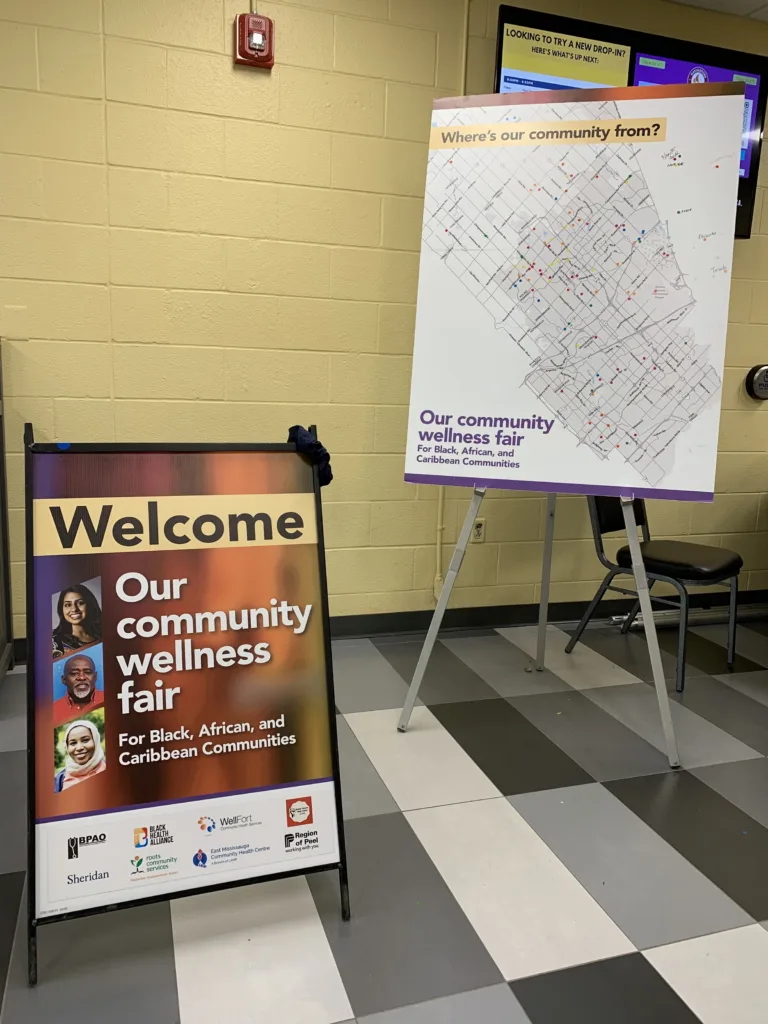
We shared all the granular pieces that we had, our quantitative data about case counts and maps, and asked, “Can you fill us in, what do you know, what can we bring here?” Sharing our quantitative data with community partners was a pivotal point in building trust with them. They were able to provide the context about what was happening where and why. They were also able to point to trusted leaders that needed to be part of the conversations, for example, physicians from the Black Physicians’ Association of Ontario and leaders from the local faith communities. These were the people we needed in the room to co-design local clinics in trusted places where people were already gathering.
Through these discussions, we learned more about barriers community members were encountering. Language and technology were huge barriers. At that time, it was like “The Hunger Games” to book your appointment at the mass immunization clinics. There were no walk-ins, you had to be able to navigate the provincial booking system, and you had to be on there at 8 o’clock in the morning the day it opened. That didn’t work for many people, including shift workers, people without reliable internet, or people who didn’t have phones or devices.
Our partners reinforced that it takes time to build trust. They noted, “The first clinic turnout is going to be low, you will feel like it’s failed, but that’s the process. Stay determined to be present with us in this community, and it will grow from there.”
Actioning community expertise to improve immunization response
One of the partner-identified clinic locations was the Malton Community Centre. Implementing the knowledge and expertise of community leaders and partners, we did several fundamental things differently at this site with a goal to increase vaccination uptake.
Community Health Ambassadors, hired by community agencies through the province’s High Priority Community Strategy, helped to inform the clinic planning process. These individuals were from the communities and engaged people door-to-door and in public spaces. They answered questions, listened to insights, and provided information to support decision making. They reported back what they were hearing to ensure the immunization process was responsive.
At the clinic, we hired security officers who were members of the community, selected by organizations we were working with, and they wore plain clothes. This was important as interactions with security, police or other uniformed officers were a barrier to attending the clinic for many community members.
There was concern that if people who are undocumented go and get vaccinated, the government will know who they are and where they are, putting them, their family and their livelihood at risk. To address this, we actively promoted that no documentation was required for immunization. If people were not comfortable giving an address, we used the address of the clinic. We identified some notes or characteristics in their file so we could record their follow-up doses, but we didn’t require formal identification or personal details.
We took some risks at this clinic by doing things that weren’t fully supported by the Ministry or by other public health units at that time. For the first time, we opened a clinic to walk-ins. This was discouraged because of concerns that a mass of people would show up and the clinic would become unmanageable. However, we had heard from the community members that “this has to be a walk-in model, this has to be accessible and open for people.”
Navigating pushback at multiple levels
In response to doing things differently, we had to navigate pushback at multiple levels. We had pushback from the public about our focus on the Black community, from the government who compared our immunization rates in Peel to the rates in Toronto, and even from partners about the resources we were using. For example, we relied on corporate partners to find properties, manage leases and negotiate equipment. Sometimes those partners pointed out that it took a lot of resources to run the clinic when only five people showed up.
We had to remain firm that we had worked with the community to determine where to go, when and why. We were navigating mistrust towards service providers, and it would take time for immunization rates to climb. We did reach the target outcomes for vaccination, but it took time and patience. Five today — we had to be patient, leave the clinic there — and eventually five turned into 25, turned into 50 and 100 and more.
We were lucky to have commitment from invested partners to make this a success together. Thanks to those partners, we had qualitative data to supplement the quantitative epidemiological data, making the approach feel indisputable. Standing up to everyone was the hardest part of the vaccination program, but it was easier to do with partners by our side.
Supportive leadership was critical to navigate challenges associated with disrupting the status quo. We had the support of Peel Region, our Commissioner of Health and the Medical Officer of Health to do things differently. Our leaders were willing to set the context for us, to stand up, push back and say, “We need to do this for our community.”
Embracing humility in delivering programs that meet community needs
Traditionally, public health leaders and decision-makers have perceived themselves as the expert. The thinking has been that we have the research data and we know what is best for the community. However, while we might have ideas and expertise from a particular perspective, we are not the experts. The community is the expert in their lived experience, in what life looks like on the ground, and in what will work or not in this environment.
While we might have ideas and expertise from a particular perspective, we are not the experts. The community is the expert in their lived experience.
In the immunization program, we tried to shift our approach to emphasize that we don’t know everything. Part of that was stepping back from what we thought was right, because if the community was not ready, we needed to reframe. We had to be curious and seek to understand as opposed to seek to explain our perspective or drive a particular initiative forward. A message we reinforced with our team was “We are going to listen first, and we are going to talk last.”
We can’t underestimate the power the community had in making this success possible. Together, the partners looked at our common goal — to keep everyone safe and end COVID-19 — and asked, “OK, what do we each bring to the table in terms of our strengths to do that together?” Community leaders brought resources and expertise to the table. The Peel Region leadership standing up and doing this alone wouldn’t have been enough.
We remember a moment from a planning meeting where one of our partners, understandably at their wit’s end, said, “We will never be able to do this. Your systems and you are all racist.” And we were like, “Yes, you are right. What are we going to do about it together?”
Incorporating learnings beyond the pandemic
Public health organizations tend to be hierarchical; however, the culture of in-house services has shifted. The legacy from the Peel Region COVID vaccination effort is the health equity approach we are now working to take to all our services, the way we value relationships and the way we involve community. Sustaining this culture will require supporting broad organizational shifts.
We are setting up internal structures, informed by this work in community, that cascade from leadership to management to all staff. The goal is to ensure that health equity is embedded into our systems and structures, and that health services, programs and systems are equitable, just and work for everyone. To do this, we are interviewing partners to make sure we understand how to build on lessons from the COVID-19 immunization response. We are sharing stories across the organization to help people see how a shift in perspective will reframe how we plan, prioritize, develop and implement programs.
Some of the resulting strategies include:
- Actively promote and advocate for health equity.
- Work directly with communities and groups to bring voice to lived experience.
- Create an environment that is open and safe, and invites the identification of unearned privilege.
- Champion “progress over perfection.”
- Invite and actively engage staff in discussions and decisions about health equity.
- Overcome internal silos and barriers across health services, human services and corporate services, and within the region.
We built a system map to understand where we have relationships within the region, where there are power dynamics within those relationships, and how those different tables or working groups interact with one another. This will help us understand the area and spheres of influence, and how we can utilize them to move forward and sustain the change.
We’ve learned that difficult conversations are necessary to create those moments of trust building. This can be difficult in a hierarchical, permissions-based organization, but we need to prepare staff to be able to have the courage to say, “You’re right.”
See Sustaining momentum from the COVID-19 pandemic to drive organizational change for health equity to read more about how the learnings from the COVID-19 response in Peel Region has influenced our work post-pandemic.
Lessons learned

Quantitative (epidemiological) data does not tell the whole story. Qualitative data, in the form of partner or community member experience or expertise, is necessary for appropriate, impactful, evidence-informed public health decision-making and response.

To be in relationship with community organizations and community members, public health must be willing to listen deeply, show humility, be patient and share power.

Disrupting the status quo — that is, advancing health equity — requires persistence and patience.

Organizational culture shifts are possible and needed to sustain lessons or advancements in equity-informed programs and services.
1 Structural and social determinants of health, not individual or community decisions or behaviours, are the root causes of disproportionately high case numbers. To learn more, visit the NCCDH Resource Library.
Background
Region of Peel delivers essential social, health and public services to 1.5 million residents and over 175,000 businesses in Brampton, Caledon and Mississauga, Ontario. Peel is highly diverse with 69% identifying with a racialized group (compared to 34% of Ontarians). Peel’s racialized population has increased by 72% since 2006, and 52% of Peel’s population are immigrants.
More demographic info can be found here.
To learn more about the initiative described in this story, contact the National Collaborating Centre for Determinants of Health, at nccdh@stfx.ca.
Do you have an idea for an Equity in Action story? If you have heard of other health equity-promoting initiatives in Canada that we should share, please let us know.